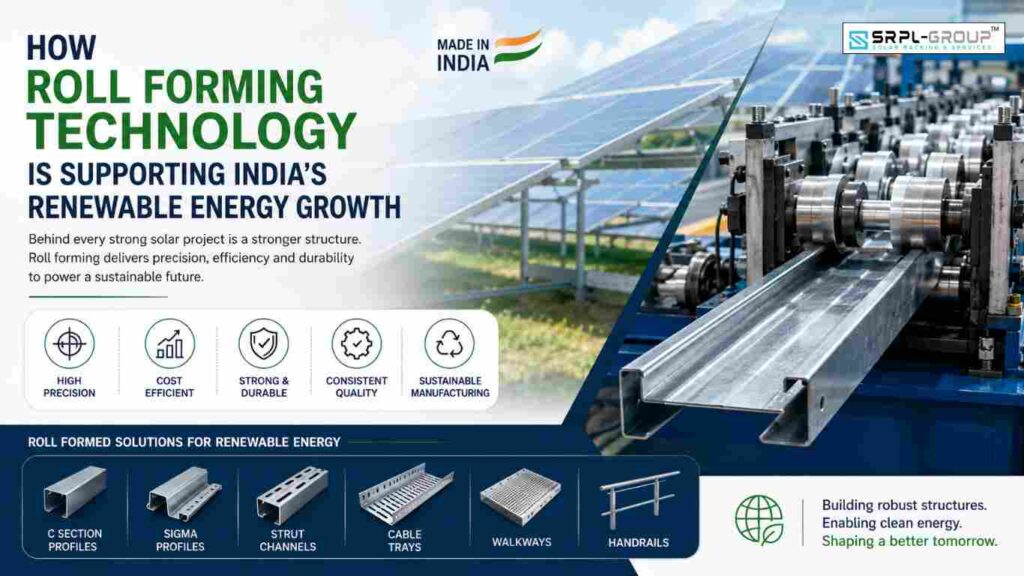
India’s renewable energy sector is expanding at an unprecedented pace, with solar power leading the transition toward cleaner and more sustainable energy. While solar panels often receive the spotlight, the success of every solar project depends heavily on the quality of its structural components. This is where roll forming technology is playing a transformative role.
What is Roll Forming?
Roll forming is a continuous manufacturing process in which a metal coil passes through a series of rollers that gradually shape it into a precise profile. Unlike traditional fabrication methods that involve extensive cutting, welding, and machining, roll forming produces components quickly, consistently, and with minimal material waste.
The process is widely used to manufacture:
– Solar mounting structures
– C Sections and Sigma Profiles
– Strut channels
– Cable trays
– Walkways and handrails
These components form the backbone of modern solar installations.
Why Roll Forming Matters for Solar Projects
Renewable energy projects require structures that can withstand wind loads, temperature variations, corrosion, and decades of outdoor exposure. Roll-formed sections offer several advantages that make them ideal for solar applications.
High Precision
Every profile is produced with consistent dimensions, ensuring faster installation and better alignment at site.
Material Efficiency
The process minimizes scrap generation, reducing overall project costs.
High Strength-to-Weight Ratio
Roll-formed sections provide excellent structural performance while remaining lightweight, which simplifies transportation and installation.
Scalability
Large volumes can be produced quickly, making roll forming ideal for utility-scale solar projects.
Supporting India’s Solar Expansion
India is adding solar capacity across utility-scale parks, commercial rooftops, industrial facilities, and agricultural projects. Each installation requires thousands of meters of structural profiles. Roll forming enables manufacturers to meet this demand with speed and consistency.
For EPC contractors, this translates into:
– Faster project execution
– Reduced on-site fabrication work
– Improved quality control
– Lower installation costs
As project sizes continue to grow, the ability to supply standardized, high-quality components becomes increasingly important.
The Role of Advanced Materials
Modern roll forming lines can process a variety of materials suited for renewable energy applications, including:
Material
Benefit
GI (Galvanized Steel)
Cost-effective corrosion protection
Galvalume
Enhanced durability in harsh environments
ZAM Coated Steel
Superior corrosion resistance for long service life
Aluminum
Lightweight and highly corrosion resistant
The combination of advanced materials and precision roll forming results in structures that can perform reliably for 25 years or more.
Beyond Solar Mounting Structures
Roll forming is not limited to module support structures. It is also used to manufacture:
– Cable trays for organized and safe cable management
– Walkways that provide secure access for maintenance teams
– Handrails and safety systems for rooftop and utility-scale projects
– Custom profiles for specialized renewable energy applications
This versatility makes roll forming a key manufacturing technology across the entire solar ecosystem.
A Strategic Advantage for Indian Manufacturing
The push for Make in India and domestic renewable energy manufacturing is creating strong demand for locally produced components. Roll forming supports this trend by enabling Indian manufacturers to deliver high-quality products with shorter lead times and better supply-chain reliability.
For companies investing in renewable energy infrastructure, sourcing roll-formed components from domestic manufacturers can improve project timelines and reduce logistics challenges.
Conclusion
As India accelerates its renewable energy journey, roll forming technology is becoming an essential enabler of growth. Its ability to produce precise, durable, and cost-effective structural components at scale makes it the preferred manufacturing process for solar mounting systems and related infrastructure.
From C Sections and Sigma Profiles to cable trays and walkways, roll-formed products are helping build the backbone of India’s clean energy future. For manufacturers, EPC contractors, and project developers alike, investing in high-quality roll-formed solutions is no longer just an option—it is a strategic advantage in the rapidly expanding renewable energy market.
FAQ Section
Q1. What is roll forming technology? Roll forming is a continuous manufacturing process used to produce precise metal profiles from steel coils.
Q2. Why is roll forming important for solar projects? It provides strong, accurate, and cost-effective structural components for solar installations.
Q3. Which products are commonly manufactured using roll forming? C Sections, Sigma Profiles, solar mounting structures, cable trays, walkways, and strut channels.
Q4. What are the advantages of roll-formed sections? High strength, dimensional accuracy, faster production, and reduced material wastage.
Q5. Can roll-formed products withstand outdoor conditions? Yes, they can be manufactured using GI, Galvalume, ZAM, and Aluminum for enhanced corrosion resistance.
Q6. What is the difference between roll forming and fabrication? Roll forming is a continuous automated process, while fabrication involves cutting, welding, and assembly operations.
Q7. Which is better for solar structures: roll-formed sections or fabricated sections? Roll-formed sections typically offer better consistency, faster production, and cost efficiency for large-scale projects.
Q8. What industries use roll-formed profiles? Solar energy, construction, infrastructure, automotive, warehousing, and industrial manufacturing.
Q9. Are custom roll-formed profiles available? Yes, profiles can be customized based on project requirements, dimensions, and load specifications.
Q10. How long do roll-formed solar structures last? Depending on the material and coating, they can provide reliable performance for 25 years or more.
<
<
<
<
<
<
<
This website uses privacy settings to ensure you get the best privacy experience on our website.