
FABRICATION
Fabrication Process Overview
Our fabrication process is structured to deliver precise, durable, and project-ready metal components for industrial and solar mounting applications. Each stage is carefully executed to maintain dimensional accuracy, structural strength, and consistent quality.
The process includes precision punching and cutting to prepare components as per approved drawings, followed by bending and forming to achieve the required profiles and load-bearing performance. Welding and sub-assembly are carried out where necessary to ensure structural integrity and proper alignment.
To enhance durability and corrosion resistance, components undergo surface treatments such as galvanization or powder coating as per project requirements. Every fabricated part is then quality-checked before being securely packed and dispatched for efficient on-site installation.
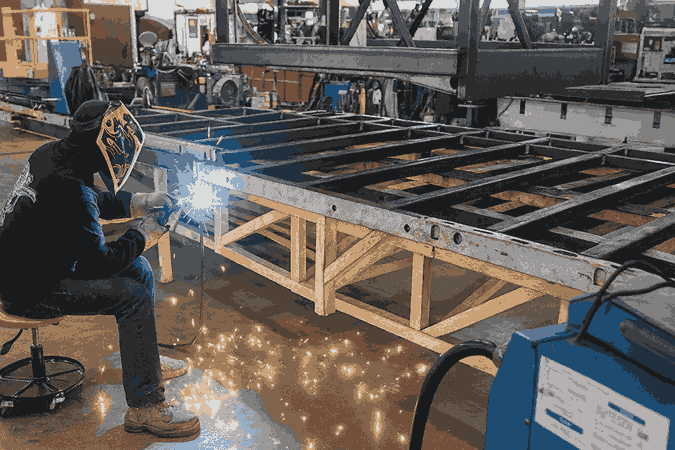
Precision Cutting
High-Strength Welding
Quality Finishing
Accurate Forming
Advanced Machining
Strict Inspection
Fabrication Workflow
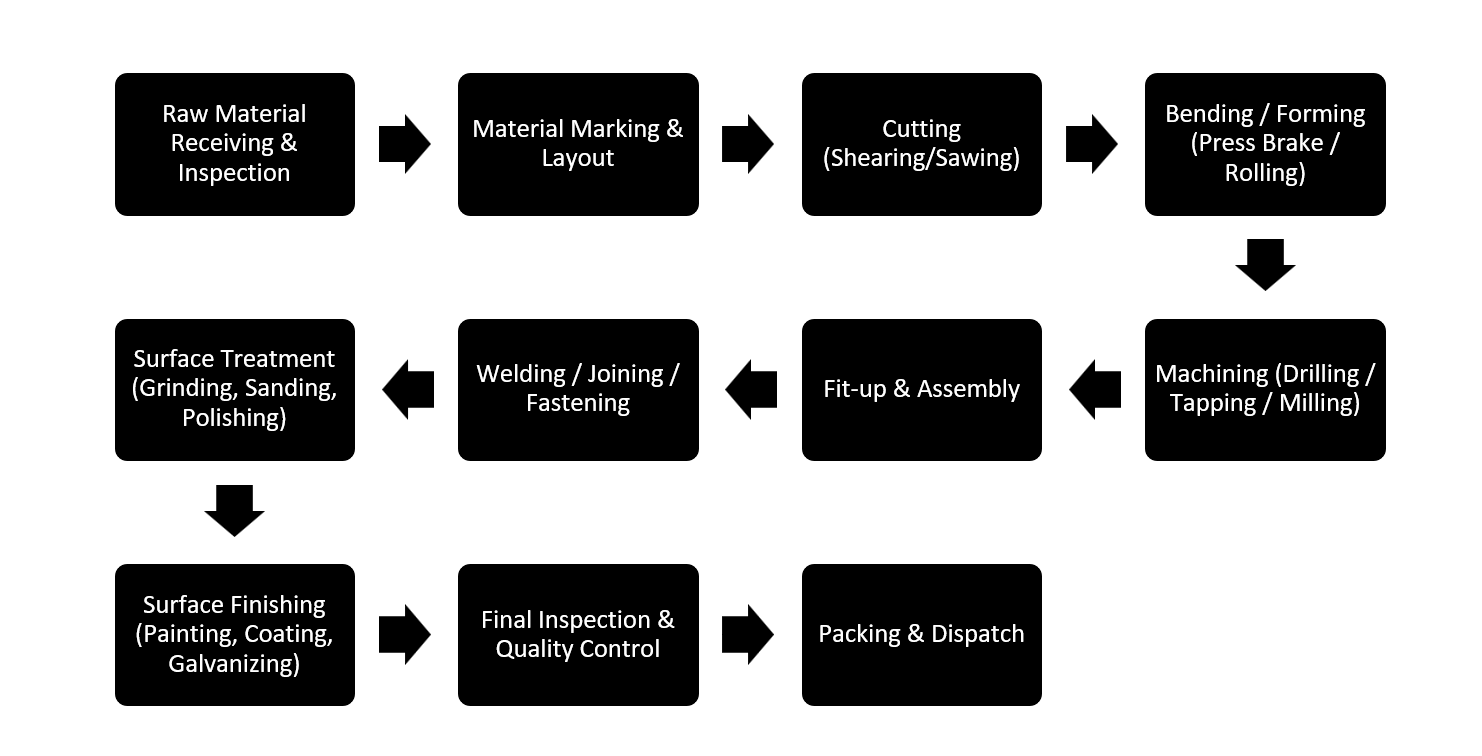
Technical Explanation of Fabrication Workflow
Raw Material Receiving & Inspection
Incoming metal stock is verified for correct alloy grade, dimensional tolerance, and physical condition as per the material test certificate (MTC). Any deviations such as warping, corrosion, or surface defects are identified before acceptance.
Material Marking & Layout
Engineering drawings are used to lay out reference lines, cut paths, bend allowances, and machining points on the raw stock. Precision marking tools and layout techniques ensure minimal material wastage and accurate downstream processing.
Cutting (Shearing / Sawing)
Materials are cut to specified dimensions using shears, band saws, or CNC saw systems, depending on thickness and geometry. The objective is to achieve clean edges, maintain dimensional tolerance, and reduce heat-affected zones (HAZ).
Bending / Forming (Press Brake / Rolling)
Press brakes, rollers, or hydraulic forming machines are used to produce bends, curves, and structural shapes. Forming parameters such as tonnage, bend radius, and spring-back compensation are controlled for accuracy.
Machining (Drilling / Tapping / Milling)
Features such as drilled holes, threaded sections, slots, and milled pockets are produced using conventional or CNC machining. Precision machining ensures proper assembly fit, functional accuracy, and tolerance compliance.
Fit-up & Assembly
Components are aligned, jigged, and clamped to maintain geometric accuracy before welding or fastening. Proper fit-up ensures joint integrity, dimensional stability, and reduces distortion during joining.
Welding / Joining / Fastening
Welding processes (MIG/TIG/Arc) or fastening methods (riveting, bolting) are applied based on structural requirements. Parameters such as heat input, penetration, and joint quality are controlled to meet engineering specifications.
Surface Treatment (Grinding / Sanding / Polishing)
Weld beads, sharp edges, and surface irregularities are removed using grinding, sanding, or polishing. Surface conditioning enhances appearance, removes imperfections, and prepares the material for final finishing.
Surface Finishing (Painting / Coating / Galvanizing)
Components receive corrosion-resistant finishes such as powder coating, spray painting, or hot-dip galvanizing. These finishes improve durability, UV resistance, and environmental protection based on the end-use application.
Final Inspection & Quality Control
Dimensional checks, weld inspections, coating thickness tests, and visual examinations are performed to ensure compliance with technical specifications. Non-conformities are flagged and corrected before approval.
Packing & Dispatch
Finished components are packed using protective materials to prevent transit damage, then labeled and prepared for safe shipment. Logistics documentation is completed to ensure traceability and correct delivery.
⭐ FAQ — Fabrication
What is metal fabrication?
Metal fabrication is the process of cutting, forming, machining, welding, and assembling metal components to create finished industrial or structural products.
What materials are commonly used in fabrication?
Fabrication typically uses metals such as steel, stainless steel, aluminium, copper, and galvanized sheets depending on the application and strength requirements.
What processes are involved in fabrication?
Key fabrication processes include shearing, laser cutting, bending, drilling, tapping, welding, grinding, surface finishing, and final inspection.
How do you ensure accuracy and consistency in fabricated parts?
Accuracy is maintained through CNC machining, precision tooling, calibrated measuring instruments, and strict quality control checks at every stage.
Do you provide custom fabrication based on drawings?
Yes, custom fabrication can be carried out as per client drawings, CAD models, sample components, or application specifications.
What surface finishing options are available?
Common finishing solutions include powder coating, painting, galvanizing, polishing, and plating to enhance corrosion resistance and appearance.